- Stator Earth Fault Protection Definition: Stator earth fault protection limits ground fault current to minimize damage to the stator core and winding.
- Ground Impedance Role: Grounding the stator with high impedance can reduce fault current but may lower relay sensitivity, requiring additional sensitive relays.
- Resistance Neutral Earthing: In this method, the stator’s neutral point is grounded through a resistor, which is connected with a current transformer and protective relay.
- Relay Types: Depending on the connection method, either an inverse time relay (for direct substation connection) or an instantaneous armature attracted relay (for star-delta transformer connection) is used.
- Alternative Grounding Method: A distribution transformer and resistor setup can also ground the stator, with an overvoltage relay ensuring protection.
Stator earth-fault protection limits earth current when a stator winding of an alternator goes to earth. The stator star point is earthed through an impedance so the current is small enough to limit burning of the core and winding. If that impedance is high, earth current can sit below rated current. Phase differential relays then may not see the earth fault.
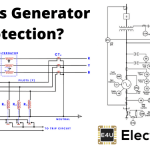
A sensitive earth-fault relay is therefore applied with differential protection of alternator. The arrangement for stator earth fault protection follows the neutral-earthing method. For resistance earthing, the stator star point goes to earth through a resistor.
A current transformer sits in the neutral-to-earth connection, with a protective relay on its secondary. The alternator may feed a substation busbar directly or through a star delta transformer. On a direct-connected machine an inverse-time relay grades with other system earth-fault relays. On a unit-connected machine the earth-fault loop is limited to the stator and the transformer delta, so an instantaneous attracted-armature relay is usual.
That is why an instantaneous attracted-armature relay is then connected across the CT secondary.
A simple resistance-earthed 51G or 59G scheme does not cover 100 percent of the stator. It sees about 90 to 95 percent of the winding from the terminals. The last few percent near the neutral need a complementary 100 percent scheme, such as third-harmonic undervoltage or subharmonic injection.
How much of the winding that 59G or 51G sees depends on the earthing resistance and the relay setting. The same high-resistance earthing can use a distribution transformer instead of a resistor in the primary path. The transformer primary sits between earth and the stator star point.
The secondary is loaded by a resistor. An overvoltage relay also sits across that secondary. Maximum earth-fault current is set by the size of the transformer and the loading resistor R.
That secondary resistance reflects to the primary by the square of the turns ratio and becomes the high resistance in the stator neutral-to-earth path.