- Differential Protection Definition: Differential protection is a method used to clear internal faults in the stator winding of a generator or alternator.
- Current Transformers: Two sets of current transformers (CTs) are used, one on the line side and one on the neutral side, and their characteristics must match to avoid relay malfunctions.
- Stabilizing Resistor: A stabilizing resistor in series with the relay prevents operation due to external faults or CT saturation.
- Percentage Biasing: Percentage biasing in differential relays helps manage spill current from mismatched CTs, preventing unwanted relay operation.
- Relay Operation: The differential relay operates during internal faults when the operating coil’s torque overcomes the restraint coil’s torque, ensuring reliable protection.
Differential protection trips for an internal fault in the stator winding of a generator or alternator. It compares current at each end of the winding.
That differential protection is applied with a longitudinal differential relay.
instantaneous attracted armature type relays are used because they operate with little intentional delay. They still need matching CTs and restraint or a stabilizing resistor so CT saturation on an external fault does not trip them.
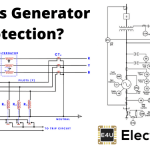
Each phase has two current transformers. One CT sits on the line side of the generator and the other sits on the neutral side.
The CTs in each phase should have the same ratio and magnetizing curve. A mismatch can send spill current through the operate coil on an external fault or in normal load. In a high-impedance scheme a stabilizing resistor in series with the relay holds that spill below pickup. A percentage-biased relay uses restraint instead of, or as well as, that resistor.

Use dedicated CTs for this function. Shared CTs pick up extra secondary burden from meters and other relays and that burden is rarely equal at both ends. All current transformers for differential protection of generators or alternators should have the same characteristics. In practice the line-side and neutral-side CTs still differ a little.
Those mismatches send spill current through the operate coil. Percentage bias raises the pickup as through current rises, so that spill does not trip the relay.
A percentage-biased relay has two restraint coils and one operating coil per phase. Current in the operate coil closes the contacts and trips the circuit breakers. Current in the restraint coils opposes that close. On an external fault the restraint current rises with the through current and holds the relay. On an internal stator fault the two CT currents no longer cancel, so operate current exceeds the biased setting and the contacts close.
Set pickup and bias from the largest allowed CT mismatch plus a margin.
The spill current that just operates the relay, expressed as a percentage of the through-fault current that produced it, is the bias setting.