- Inter Turn Fault Definition: Inter turn faults happen when the insulation between conductors in the same stator winding slot is damaged.
- Detection Methods: These faults can be detected using stator differential protection or stator earth fault protection.
- Importance of Stator Inter Turn Protection: High voltage generators and modern large generators need stator inter turn protection to prevent faults.
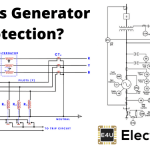
- Cross Differential Method: This method uses parallel paths and current transformers to detect inter turn faults by triggering a differential relay.
- Alternative Protection Scheme: Another method uses second harmonic currents to activate a polarized relay, with a negative phase sequence relay preventing false triggers during external issues.
An inter-turn stator fault shorts two turns of the same phase in one slot. Longitudinal differential and stator earth fault protection often miss it until the puncture reaches another phase or earth. A dedicated scheme is used on machines with many conductors of different potential in the same slot. The fault often becomes an earth fault later. The dedicated scheme is meant to see it earlier.
High voltage generators pack many conductors per slot. That raises inter-turn voltage. Large high-voltage units therefore use a dedicated turn-fault scheme. Small machines that already see the fault on 87G or 64G as soon as it goes to earth often omit the extra scheme.
Several methods exist for inter turn protection to the stator winding of generator. Cross-differential (split-phase) is the usual scheme when each phase has two parallel paths.
Each path has identical current transformers (CTs), and their secondaries are cross-connected. The cross-connection is used because the currents in both CT primaries enter the winding in the same sense, unlike differential protection of transformer where current enters one end and leaves the other.
A differential relay and a series stabilizing resistor sit across the CT secondary loop. An inter-turn fault in one path unbalances the two secondary currents and operates that 87 element. Apply the scheme on each phase separately.
Another scheme of inter turn fault protection of stator winding of generator looks at the field circuit rather than the stator parallels. An internal stator fault induces second-harmonic current in the field winding and exciter. That current can operate a sensitive polarized relay through a CT and a filter. The scheme does not replace 87G or 64G and it is not independent of every winding arrangement.
A negative-phase-sequence relay supervises the scheme so external unbalanced faults or asymmetrical load do not operate the polarized element. For unbalance outside the generator zone the NPS relay blocks this trip. Rotor heating from second-harmonic and negative-sequence current is then left to the 46 function and system backup, not this turn-fault scheme. The main circuit breaker still trips only if those other functions operate.