- Power System Protection Definition: Power system protection is defined as the methods and technologies used to detect and isolate faults in an electrical power system to prevent damage to other parts of the system.
- Circuit Breakers: These devices are crucial for automatically disconnecting the faulted part of the system, ensuring the stability and safety of the remaining electrical grid.
- Protection Relays: Protection relays monitor the electrical network and initiate the tripping of circuit breakers when they detect anomalies, critical for mitigating damage during faults.
- Functional Requirements: Essential attributes for protection relays include reliability, selectivity, sensitivity, and speed, ensuring they perform effectively under fault conditions.
- Station Battery Importance: Station batteries provide necessary DC power to operate circuit breakers during power failures, playing a vital role in the continuous protection of the power system.
A protection system in power system detects abnormal electrical conditions and commands the equipment needed to isolate a fault. A complete scheme includes sensing, relays, communications where required, a dependable DC supply and trip circuitry. Common power system protection functions include differential relays, restricted earth fault protection, directional and distance protection. Applications include transformer protection, generator protection, transmission line protection and capacitor-bank protection. These functions form part of the wider protection of power system.
Engineering work also covers switchgear, instrument transformers, voltage sensing through a potential transformer and each associated protection relay.
Close, trip, indication and alarm circuits connect the protection scheme to its circuit breakers.
Objective of Power System Protection
The objective of power system protection is to detect a fault and isolate the affected part of the electrical power system in the intended sequence. Selective clearing limits equipment damage and helps healthy sections remain in service.
A relay issues a trip command and the circuit breaker interrupts the fault current. Primary and backup schemes are coordinated so that failure of one component does not leave the fault uncleared.
Protection System in Power System
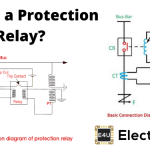
The diagram shows a basic protection system in power system, from instrument-transformer inputs through the relay and DC trip circuit to the circuit breaker.
A current transformer and voltage transformer supply scaled electrical quantities to the relay. The relay evaluates these inputs, including the signal from the CT, against its protection logic and settings. When a trip condition is met, an output contact or electronic interface completes the DC trip circuit. The energised trip coil releases the operating mechanism so the circuit breaker opens. This description covers the functional chain; modern numerical relays do not rely on the simple electromechanical coil action shown in the legacy example.
Functional Requirements of Protection Relay
Reliability
Reliability includes dependability when the relay should operate and security when it should remain restrained. A scheme must perform correctly after long periods without a fault, so testing and maintenance cover the complete protection path.
Selectivity
Selectivity means the protection system identifies and isolates the intended element of the electrical power system. Time, current, impedance, direction, communication and zone boundaries may be coordinated so the nearest suitable device clears the fault while backup protection remains available.
Sensitivity
Sensitivity is the ability to detect the minimum fault or abnormal quantity within the protected zone while remaining secure for load, measurement error and permitted system conditions. Settings must follow a documented study rather than a generic threshold.
Speed
Operating time must be fast enough to limit fault damage and meet stability requirements, but it must also preserve coordination. Primary protection should clear the fault first. If the primary path or breaker fails, backup protection operates after the time or logic margin defined by the coordination study.
Important Elements for Power System Protection
Switchgear
Interrupting equipment may include a legacy bulk oil circuit breaker, minimum oil circuit breaker, SF6 circuit breaker, air blast circuit breaker or vacuum circuit breaker. The mechanism may store energy in a spring, hydraulic or pneumatic system, with solenoids used for release or direct operation. A Circuit breaker interrupts the fault after receiving the protection-system command; its mechanism is distinct from the relay, sensing and DC-supply components.
Protective Gear
Protective relays measure current, voltage, frequency, impedance or derived quantities and apply logic suited to the protected element. Functions may use definite-time, inverse-time, differential, distance, directional or communication-assisted principles. When the configured conditions are met, the relay sends a trip command to the associated interrupting device.
Station Battery
Station DC systems supply relays, control circuits and trip coils independently of the AC auxiliary supply. Their batteries, chargers and distribution circuits must remain available during faults and loss of station AC. In an electrical substation, continuity, capacity, voltage and trip-path integrity require monitoring and maintenance so the circuit breaker can operate when demanded.