- Capacitor Bank Protection Definition: Protecting capacitor banks involves preventing internal and external faults to maintain functionality and safety.
- Types of Protection: There are three main protection types: Element Fuse, Unit Fuse, and Bank Protection, each serving different purposes.
- Element Fuse Protection: Built-in fuses in capacitor elements protect from internal faults, ensuring the unit continues to work with lower output.
- Unit Fuse Protection: Limits arc duration in faulty units, reducing damage and indicating fault location, crucial for maintaining capacitor bank protection.
- Bank Protection Methods: Use voltage and current sensitive relays to detect imbalances and protect the bank from excessive stress and damage.
Like other power equipment, a shunt capacitor bank can experience internal and external electrical faults. Its protection must limit damage, detect failed elements or units and isolate conditions that exceed the bank rating. The selected scheme depends on bank voltage, grounding, unit arrangement, fusing method and the value of each capacitor. Protection is therefore coordinated for the specific capacitor bank rather than chosen from cost alone.
- Element fuse.
- Unit fuse.
- Bank protection.
Element Fuses
In an internally fused capacitor unit, each fuse is connected in series with one capacitor element or a small element group. If an element fails short circuit, its fuse clears and removes that element from service. The unit continues operating with lower capacitance, while voltage on the remaining series elements rises slightly. Internally fused construction is one design option; externally fused, fuseless and unfused banks use different failure behaviour and protection.
Unit Fuse
An external unit fuse interrupts current to a failed capacitor unit and limits the duration and energy of the internal arc. The remaining units in the capacitor bank may stay energised if the resulting unbalance and voltage stress remain within the protection settings and equipment ratings. Continued operation is a design decision, not an automatic result for every unit failure.
An operated external fuse also identifies the failed unit. Fuse selection must coordinate with unit rupture limits and withstand normal capacitor current, tolerances, switching inrush, overvoltage and harmonics. A fixed percentage above full-load current is not suitable for every design; engineers use the applicable fuse standard, bank study and manufacturer data. Each unit also needs a discharge resistance or another approved discharge device so residual voltage decays after isolation.
Bank Protection
When a capacitor element or unit is removed from a series group, the same phase voltage is shared by fewer healthy elements. Their individual voltage therefore rises. Alarm settings should detect a tolerable failure, while trip settings should operate before the calculated overvoltage can cause a cascading failure. The allowable level comes from the bank design and unit rating rather than a universal 110% operating rule.
Bank relays must detect internal unbalance early enough to protect healthy units. They also commonly cover terminal faults, phase and ground overcurrent, overvoltage, thermal overload and breaker failure. Settings compensate for inherent manufacturing and system unbalance so the scheme remains sensitive without false operation.
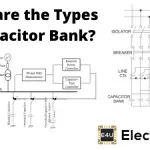
The figure shows one voltage-unbalance form of capacitor bank protection. The capacitor bank is star connected, and a voltage transformer measures each phase. The secondaries of the three potential transformers form a broken-delta circuit. With balanced phase voltages, the residual voltage is near zero. A failed unit changes the phase relationship, producing residual voltage. Separate calculated thresholds can provide alarm and trip outputs.
The voltage-unbalance relay may use a lower threshold for alarm and a higher threshold for trip. Its time delays must ride through switching transients but act before damaging unit overvoltage develops. Voltage transformers or dedicated discharge coils can also help discharge an isolated bank if they are rated for that duty.
In the next scheme, the capacitors in each phase are divided into two series sections. Voltages from discharge coils across the sections are compared through an auxiliary transformer. The normal difference is balanced out, allowing the relay to respond to a failed element or unit.
For the illustrated grounded-star scheme, a potential transformer connects between the neutral and earth. Phase unbalance produces neutral voltage across the potential transformer. The relay operates when the compensated quantity exceeds its alarm or trip setting.

In a split double-star arrangement, each phase of the capacitor bank has two parallel sections. A current transformer measures the current between their neutral points. A current-unbalance relay responds when a failure creates a difference between the two sections. Discharge coils may be installed across the phase sections for de-energised discharge.
Another form of protection of capacitor bank measures the neutral-to-earth current of a grounded star bank. After compensation for normal unbalance, excessive neutral current starts alarm or trip logic and can open the associated circuit breaker. The method is suitable only where the grounding and bank arrangement provide the measured current path.