- Maximum Power Transfer Theorem Definition: The maximum power transfer theorem is defined as a method to find the load resistance value that allows maximum power transfer from a source.
- Optimal Load Resistance: Maximum power transfer occurs when the load resistance equals the internal resistance of the source.
- Application in Networks: The theorem applies to resistive networks, ensuring maximum power transfer when the load resistance matches the network’s equivalent resistance.
- Thevenin Equivalent: In a voltage source network, the equivalent resistance for maximum power transfer is the Thevenin resistance.
- Norton Equivalent: In a current source network, the equivalent resistance for maximum power transfer is the Norton resistance.
Maximum Power Transfer Theorem
Connect a voltage source that has internal resistance (Ri) to a load (RL). The maximum power transfer theorem gives the load resistance (RL) that draws the most power from that source.
Maximum power reaches the load when RL equals Ri. The next figure is that source-and-load pair.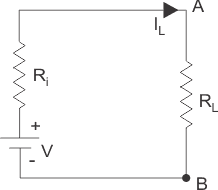
Power delivered to the load is
Differentiate that power with respect to RL and set the derivative to zero.
The result is that maximum power reaches the load when RL equals the internal resistance of the battery.
The Maximum power transfer theorem also applies to a larger resistive network.
A resistive load takes maximum power when its resistance equals the resistance seen looking back into the network from the load terminals. That resistance at the output terminals is the Thevenin equivalent resistance if the network is treated as a voltage source, as in Thevenin’s theorem for a voltage source. If the same network is treated as a current source, that resistance is the Norton equivalent resistance from Norton theorem.