- Instantaneous Relay Definition: An instantaneous relay is defined as a relay that operates with no intentional delay when the current exceeds a set threshold.
- No Intentional Delay: Instantaneous relays activate without any added delay, making them very fast in operation.
- Inherent Delays: These relays still have minor delays due to electrical and mechanical factors, but they are not intentionally introduced.
- Types of Instantaneous Relays: Examples include attracted armature relays, solenoid type relays, and balance beam relays.
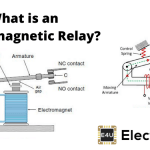
- Operation Mechanism: These relays rely on electromagnetic attraction to move a plunger or beam to close the relay contacts quickly.
A traditional electromechanical electrical relay can use a fixed coil and an iron plunger. When the measured current exceeds the pickup setting, electromagnetic force moves the plunger and closes the normally open contacts. This is one physical implementation of an instantaneous relay. The term means that the relay adds no intentional time delay; it does not mean that sensing, movement and contact operation take zero time.
Definition of Instantaneous Relay
An instantaneous relay is a relay or protection element that operates without an intentional time delay when its operating quantity crosses the set threshold. Its actual operating time is finite and is specified or tested for the particular device.
In an electromechanical relay, coil flux, magnetic force, plunger travel and contact motion create inherent delay. The coil is an inductor, but its current does not always need to reach a theoretical maximum before pickup. In a numerical relay, analogue filtering, sampling, algorithm processing and output-contact time contribute instead. Breaker opening time is separate from relay operating time.
Examples of Instantaneous Relays
Historical electromechanical examples include attracted-armature relays. An electromagnet attracts a plunger or hinged armature when the operating force produced by current exceeds the restraining force. Modern numerical relays provide several software-based instantaneous overcurrent elements, with configurable pickup and supervision.
A solenoid relay is another electromechanical example. When coil current exceeds pickup, the solenoid moves an iron plunger and changes the contact state.
A balance-beam device is also a historical instantaneous relay. Its operating quantity produces torque that unbalances the beam and closes the contacts. In every implementation, engineers must set the instantaneous element high enough to remain secure for load, inrush and external faults, while keeping it sensitive to faults in the intended zone.